An open navigation observatory

Navigation is a broadcast.
We’re listening.

NavListen is open hardware and software for recording, decoding, and independently checking the satellite signals that tell the world where—and when—it is.

Open source · Apache 2.0 · Built in public

SKY / LIVE37.7749° N
OBSERVER 01
G12
E19
C08
J03
frame stream0 anomalies
7civil constellations
in one architecture
RAWbroadcast frames
kept as evidence
OPENhardware, software,
math, and protocol
OURSindependent stations,
shared understanding

Why this exists

Coordinates deserve an independent witness.

Phones, ships, power grids, data centers, farms, and emergency services all take timing and position from radio signals sent thousands of kilometers through space. Interference is local. Bad ephemerides are global. Either can look ordinary if no one is keeping the original broadcast.

We think navigation deserves a public observatory: independent receivers, transparent math, replayable history, and enough geographic reach to tell a broken satellite from a broken sky over one neighborhood.

Trusting a blue dot is easy.

Proving it is the work.

A complete signal path

From antenna to evidence.

Each layer has a narrow job, a documented interface, and an inspectable record.

01

The observer

Listen at the edge

Our purpose-built ESP32 observer pairs a u-blox or Septentrio receiver with hardware-backed ECC identity, then forwards the raw navigation messages satellites actually broadcast.

  • u-blox + Septentrio
  • Hardware ECC identity
  • Environmental sensors
02

The wire

Keep every frame

Tiny C and ESP32 feeders reconnect, retransmit, and preserve provenance. The edge stays simple so every decoder improvement can replay history.

  • GNF1 over TLS
  • Disk spool
  • Signed observations
03

The core

Turn signals into evidence

A clean-room Go library decodes public signal specifications, propagates every orbit, and checks clocks, ephemerides, and receiver physics.

  • ICD-authored math
  • Integrity events
  • Timescale history
04

The network

Compare what the sky told us

Independent stations corroborate the same broadcast from different places. Federation makes a solo receiver part of something much larger.

  • Open API
  • Live event stream
  • Federated trust
NAVLISTEN OBSERVERREV A
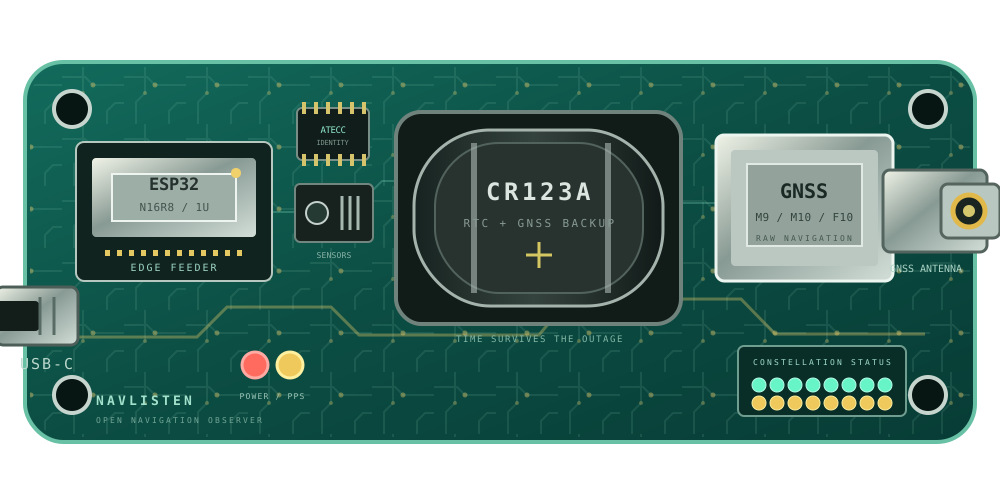
Illustrated layout of the NavListen GNSS observer board
127.0 × 50.8 MM4 LAYER

Open hardware, with a pulse

Meet the observer.

A fabrication-ready four-layer board built specifically to observe navigation. The receiver listens. The sensors add physical context. The secure element lets every observation keep its identity across the network.

Receiver
u-blox or Septentrio
single- and dual-band options
Edge
ESP32
Wi-Fi, USB-C, resilient feeder
Identity
ATECC608 + EUI-64
Non-extractable station key
Senses
Pressure · temperature · humidity
Context for physical integrity gates
Help build the first network
integrity station / livePUBLIC
Network health Nominal
Last frame0.4 s ago
Coastal observer02:4f:91:ff:fe:70:2a:11
GGPSSSBASEGalileoCBeiDouJQZSSRGLONASSINavIC
Orbit agreement≤ 0.42 macross 4 observers

Software that remembers

Ask what the sky said.

NavListen stores raw navigation frames beside decoded state. The archive can be replayed when a decoder is corrected or a new signal is added. When two receivers disagree, the original observation is still there.

  • 01
    Clean-room GNSS math

    Go decoders and orbit models authored from public interface specifications.

  • 02
    Live integrity detection

    Orbit, clock, RF, and physical plausibility become typed, replayable events.

  • 03
    Tools for people

    A versioned API, event stream, and native Integrity Station clients for the network.

One sky, many witnesses

A useful network starts with the next rooftop.

One station can preserve a broadcast. A fleet can distinguish receiver trouble from local interference. A federation can see regional systems from the places they were built to serve.

CALIFORNIA
JAPAN
INDIA
EUROPE
YOU?

There is room at the workbench

Come help us listen.

This project gets better with more disciplines, more stations, and more points of view. Curiosity is enough to begin; GNSS expertise can come later.

Put a station under your sky

Run a feeder with a supported receiver or help bring up the fabrication-ready observer board. Geographic diversity is the instrument.

I can host an observer
⟨⟩

Build the open stack

Work on GNSS decoders, Go services, embedded C, Swift clients, RF detection, data visualization, or the public API.

I want to build

Bring your perspective

Navigation needs RF engineers, researchers, technical writers, fabricators, operators, and curious people who ask better questions.

I have another idea

THE SKY IS ALREADY TALKING

Let’s hear it together.

Join NavListen